
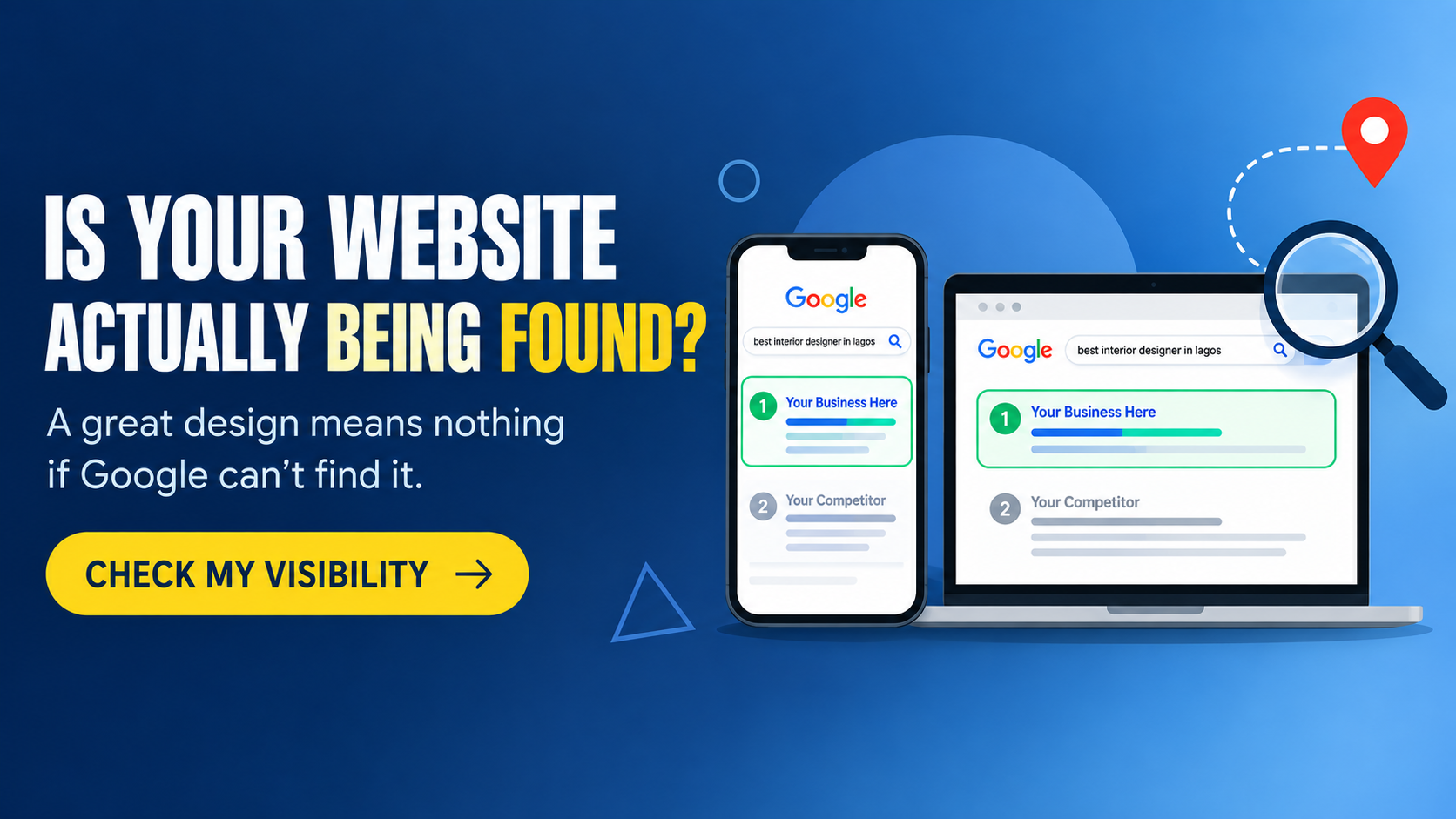
Website Performance & SEO
Why Your Website Isn’t Ranking on Google Even Though It Looks Great
A beautiful website and a visible website are two different things. Plenty of business owners build a clean, modern site, launch it, and assume Google will simply find it. Most of the time, that does not happen on its own.
What Does It Actually Mean When a Website Doesn’t Rank on Google?
Not ranking means your website does not appear on the first page of Google, or anywhere close to it, when someone searches for the products or services you actually offer. Your site can still exist, still look professional, and still be online twenty four hours a day. None of that matters if it never shows up where the people searching for you are actually looking.
Five Reasons a Good Looking Website Still Doesn’t Show Up in Search
Design and visibility are judged by completely different rules. Here are the issues that quietly keep an otherwise solid website invisible:
- No clear focus per page. A homepage trying to rank for everything at once usually ranks for nothing in particular.
- Technical setup problems. Duplicate versions of the same page, broken redirects, or a site indexed under two different addresses split your ranking signals instead of combining them.
- Slow loading speed. Google measures real page speed as a ranking factor, not just a user experience nicety.
- Inconsistent local signals. If your address or phone number is written differently across your website, your Google Business Profile, and directories, Google struggles to confirm you are a real, trustworthy local business.
- Content that does not match what people actually search. A page can be well written and still miss ranking entirely if it does not answer the exact question or phrase a real customer types in.
| Visible Website | Invisible Website |
|---|---|
| One clean web address per page, properly indexed | Duplicate or conflicting versions of the same page |
| Fast loading on mobile and desktop | Slow load times that visitors and Google both notice |
| Consistent name, address, and phone number everywhere online | Different business details across the website, directories, and Google Business Profile |
| Pages written around real search phrases | Pages written around what the business wants to say, not what customers search |
| Regularly reviewed in Google Search Console | Never checked after the site went live |
How Do I Know If My Website Has a Ranking Problem?
Run through this short self-audit. Several “No” answers usually explain a quiet, ongoing visibility problem.
| Question | ✓ Yes | ✕ No |
|---|---|---|
| Do you know how many people found your site through Google search last month? | ✓ | ✕ |
| Is your homepage reachable at exactly one web address, not two or more? | ✓ | ✕ |
| Is your business name, address, and phone number identical on your website and your Google Business Profile? | ✓ | ✕ |
| Have you checked your site in Google Search Console in the last month? | ✓ | ✕ |
| Do your main pages load in under three seconds on a phone? | ✓ | ✕ |
| Does each main page target one clear topic or service? | ✓ | ✕ |
What Happens When Your Business Isn’t Visible on Google?
It rarely feels dramatic day to day. It shows up as a slow, steady cost that is easy to miss:
- A potential customer searches for exactly what you offer, and a competitor’s site appears instead of yours
- Paid ads become the only way people find you, since organic search brings in nothing on its own
- Someone searches for your business by name near them, and a competitor’s map listing shows up first
- Marketing spend gets harder to justify, because leads cannot be traced back to a site nobody finds
- Over time, the business quietly looks less established online than smaller competitors who are simply easier to find
The Real Cost of Staying Invisible
The most expensive part of poor search visibility is never the fix itself. It is every enquiry that quietly went to a competitor instead, month after month, without ever showing up as a line item anywhere. Add up a year of that, and it is almost always far more than the cost of getting the technical and content basics right in the first place.
When a Redesign Alone Isn’t the Fix
Sometimes the honest answer is not “write more content.” A site can be well written and still stay invisible if the foundation underneath it is the real problem, such as:
- Hosting that is too slow to meet Google’s page speed expectations
- A WordPress installation that has never been properly optimized or maintained
- No SSL certificate, which both browsers and Google treat as a trust signal
- A site still spread across duplicate addresses instead of one clean, indexed version
In these cases, fixing the words on the page will not fix the ranking. The infrastructure underneath the site needs attention first. This is exactly why WordPress Hosting and Agentic WordPress Hosting exist as separate options, one gives you fast, secure hosting, the other adds continuous automated optimization on top of it. If your site is outgrowing shared hosting entirely, our recent post on what happens if you skip WordPress maintenance covers the security side of the same problem.
For the technical basics of how Google actually finds and ranks pages, Google’s own Search Central documentation is the most reliable primary source available.
Not sure why your own site isn’t showing up?
Get Your Free Website Visibility CheckFrequently Asked Questions
A new page can be indexed within days, but meaningful ranking for competitive terms usually takes a few months of consistent technical health and relevant content. Local searches with less competition can move faster than national or highly competitive keywords.
Yes. Google uses page speed and Core Web Vitals as direct ranking factors, separate from how visitors feel about the site. A slow site can lose ranking even if the content on it is genuinely good.
For local searches, yes. Google cross checks your business name, address, and phone number across your website and your Google Business Profile. Mismatches between the two weaken local ranking even when the website itself is technically sound.
Yes. Google has confirmed HTTPS as a ranking signal, and modern browsers actively warn visitors away from sites without a valid SSL certificate, which increases bounce rate and lowers trust before a visitor even reads the page.
Not necessarily. A redesign fixes appearance, not visibility. If the underlying hosting, indexing, or local listing details are the actual problem, a new design on the same foundation will rank exactly as poorly as the old one did.
Confirm your site is reachable at one single, clean web address, that your business details match across your website and Google Business Profile, and that your main pages load quickly on mobile. Those three checks catch the most common causes of poor visibility.


2 Responses
Thanks for sharing this, and honestly, you’re not alone, SPF, DKIM and DMARC
tripping people up on every new subdomain is one of the most common
frustrations we hear about. The alignment between all three is genuinely
fiddly, especially since a subdomain doesn’t automatically inherit the
parent domain’s records the way people expect it to.
You’re right that Gmail’s recent sender requirements changed the stakes
here. Setups that used to just barely get by are now failing outright,
which is exactly why getting all three to align properly isn’t optional
anymore the way it might have felt a couple of years ago.
If re-checking five times per subdomain is becoming a regular routine,
it might be worth having someone audit the DNS setup once across all
your subdomains together rather than one at a time, that usually catches
the small inconsistency that keeps forcing the re-runs. Happy to take a
look if that would help. Thanks again for reading and for the thoughtful
comment.